

Journal/Getting found on Google
How to show up when someone searches near you
For a local business, the map results matter as much as the website. Google explains fairly openly how it chooses them.
15 November 2026·2 min read
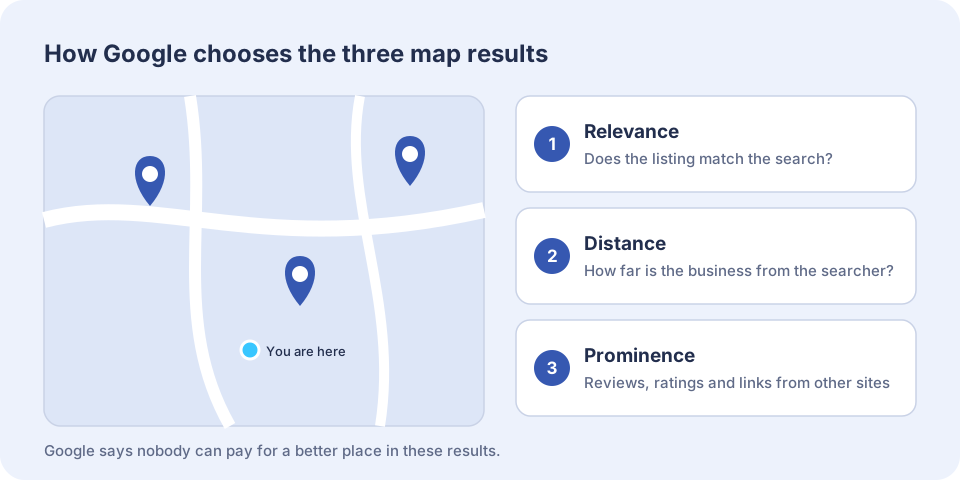
Search for a trade and a town and Google usually shows a map with three businesses above the normal results. Those three get most of the calls. The listings come from Google Business Profile, a free listing that every business with customers in a local area should claim.
How Google picks the three
Google says local results are based mainly on three things:
- Relevance: how well your profile matches what was searched for.
- Distance: how far you are from the person searching, or from the place they named.
- Prominence: how well known the business is. Google says this takes in reviews, ratings and links from other websites.
You cannot move your premises closer to the customer, and Google is clear that nobody can pay for a better local ranking. So the work is on relevance and prominence.
Get the profile right
- Claim it and verify it. Google says a verified business is more likely to be shown.
- Choose the most accurate main category.
- Fill in everything: services, areas covered and opening hours, including bank holidays.
- Add real photographs of your work, your van, your premises and your team.
- Keep it current. Wrong opening hours lose customers and trust.
Keep your details identical everywhere
Your business name, address and phone number should be written the same way on your website, your Google profile and every directory that lists you. Different versions make it harder for Google to be sure they are all the same business.
Reviews
Ask every happy customer for a review, and make it easy by sending them the link. Reply to all of them, good and bad. Google says replying shows that you value feedback, and future customers read the replies as closely as the reviews. Never buy reviews or write your own. It is against Google's rules and against UK consumer law.
Where your website comes in
Your website supports the profile. It should show the same name, address and phone number, say clearly which areas you cover, and have a proper page for each service. Behind the scenes it can also carry a short block of code that tells Google your business type, location and opening hours in a form it can read without guessing.
If you cover several towns, a page for each can help, as long as each one says something true and specific about your work there. Pages that are identical apart from the town name do more harm than good.
We set up that hidden business information on every site we build, and we check that your details match your Google profile before the site goes live. We are a London business ourselves: see web design in London.