

Journal/Getting found on Google
Why Google wants to know who is behind your website
Google tries to rank businesses that people can trust. It cannot meet you, so it looks for evidence on the page.
15 November 2026·2 min read
Google uses thousands of people around the world to check its results by hand. The guidance it gives them is public, and it asks them to look for four things in a page: experience, expertise, authoritativeness and trust. Trust is described as the most important. These are not a score that your site is given. They describe what Google's systems are being built to reward.
For a small business, that comes down to a simple question. Does this website look as though it belongs to a real, competent business that stands behind its work?
Show that you are real
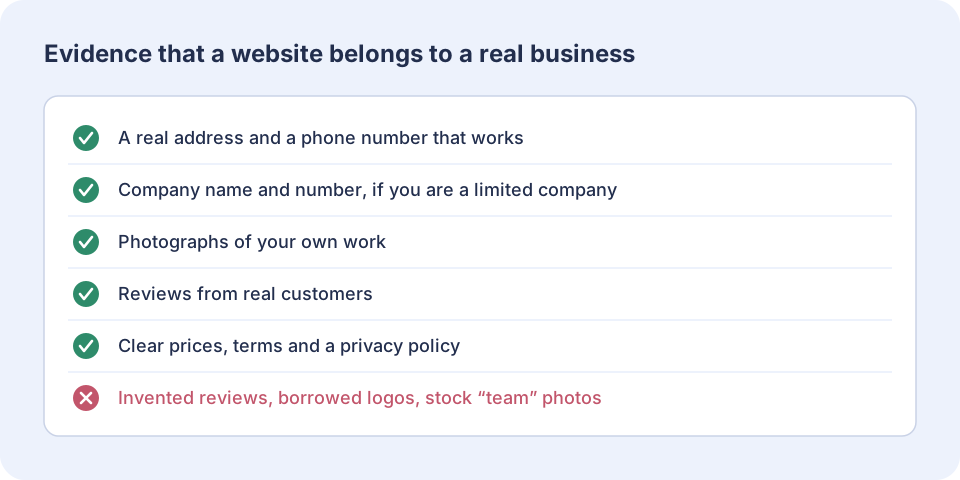
- A real address, or at least the town you are based in, and a phone number that works.
- Your registered company name and number, if you are a limited company. UK law requires these on a company website anyway.
- A short page about who runs the business. It does more than a paragraph of slogans.
- Clear prices, or clear starting prices.
- Terms, a privacy policy, and what happens if something goes wrong.
Show that you have done the work
- Photographs of your own jobs, not stock pictures.
- Case studies that say what the job was, what you did and how it turned out.
- Reviews from real customers, on Google and on your own site.
- Trade memberships, qualifications and insurance, with the scheme named so that it can be checked.
Write from experience
Advice written by someone who has done the job reads differently from text put together to fill a page. The detail gives it away: the thing that usually goes wrong, the question customers forget to ask, the reason you do it one way and not another. That kind of detail is hard to fake, which is exactly why Google looks for it.
The basics of a safe site
A site should load over a secure connection, shown by the padlock and an address beginning https. It should not throw up security warnings, and it should not be running old software with known holes in it. Sites that get hacked can be flagged in the results or removed from them.
What does not work
Invented reviews, borrowed logos, stock photographs passed off as your team, and claims you cannot back up. Some of it is against the law, all of it is against Google's rules, and customers find out.
We hold our own site to this. You will not find invented clients or made-up numbers on it, and where we quote a figure we say where it came from.