

Journal/Getting found on Google
Pictures that help you rank instead of slowing you down
Photographs sell your work better than words do. Handled badly, they are also the main reason small-business sites are slow.
15 November 2026·2 min read
For most trades the pictures do the selling. A good photograph of a finished job is worth a page of description. Pictures are also the heaviest things on nearly every website, and Google cannot see what is in them unless you tell it. Getting both of those right is one of the easier wins in SEO.
Size is the big one
A modern phone takes pictures that are several megabytes each and thousands of pixels wide. A website rarely needs more than a fraction of that. Uploaded as they are, a dozen photographs can make a page many times heavier than it needs to be.
When we tested 12 WordPress sites in one trade, the heaviest home page weighed 26 MB and another carried 8 MB of pictures. On a phone signal that is a long wait, and a slow main picture is a common reason for a page to fail Google's loading check.
Three things fix it:
- Resize each picture to the largest size it will actually be shown at.
- Save it in a modern format. WebP and AVIF give the same quality as JPEG in a much smaller file.
- Send small versions to phones and larger ones to big screens, and only load the pictures further down the page when the visitor scrolls towards them.
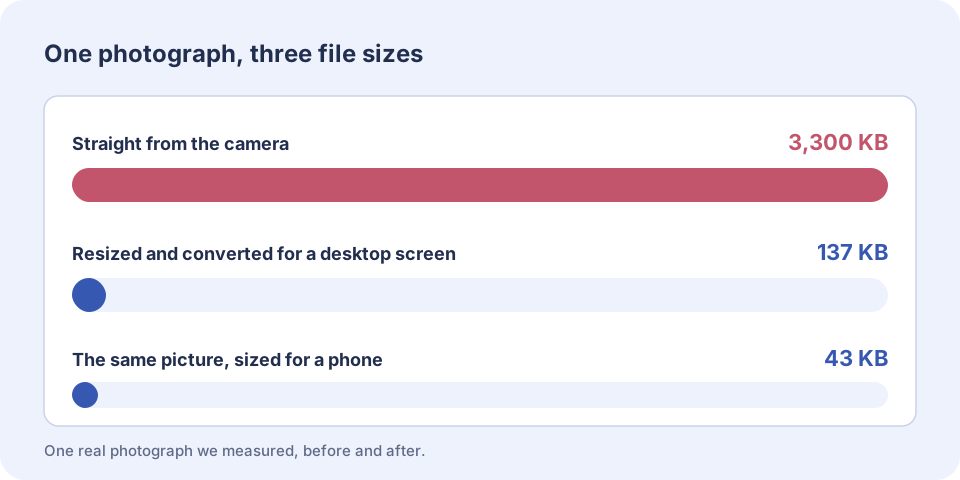
Done properly, a photograph of 3 MB can come down to somewhere between 50 and 150 KB with no difference you would notice.
Tell Google what the picture shows
Every picture can carry a short written description, known as alt text. It is read aloud to people who use a screen reader, and it is how Google learns what the picture shows. Describe it plainly. "Oak kitchen with a marble island, Guildford" is useful. "IMG_4032" is not, and neither is a list of keywords.
File names help in the same way. A file called oak-kitchen-guildford.jpg tells Google something. One called DSC00417.jpg does not.
Stop the page jumping
If a page does not know how big a picture will be until it arrives, the text jumps down when it loads. Google measures that jump and counts it against the page. Giving every picture its width and height in the code prevents it.
Use your own photographs
Stock pictures appear on thousands of other sites and tell Google and your customers nothing about you. Your own photographs of your own work are original, and they can also appear in Google's image results.
On every site we build, pictures are resized, converted and given proper descriptions as part of the job. You send us the originals and we do the rest.