

Journal/Getting found on Google
Can Google actually read your website?
Before a page can rank it has to be found, read and stored. A surprising number of sites trip at one of those three steps.
15 November 2026·2 min read
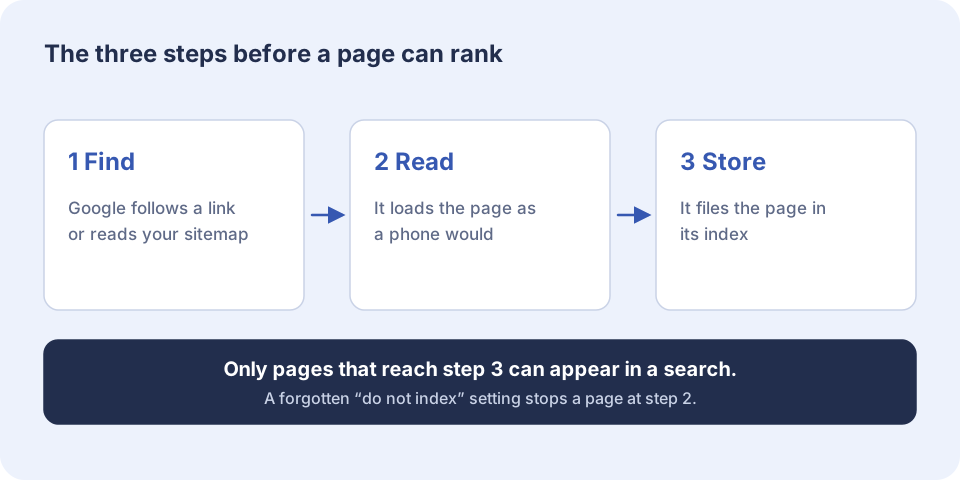
Google works in three stages. It finds a page by following a link or reading a list of pages. It reads the page. Then it stores what it read in its index, which is the huge catalogue that search results are drawn from. A page that is not in the index cannot appear for anything, however good it is.
Check whether you are in the index
Search Google for site: followed by your web address, such as site:yourcompany.co.uk. The results are the pages Google has stored. If important pages are missing, something is in the way. For a fuller picture, sign up for Google Search Console. It is free, and it shows which pages are stored, which are not, and why.
Things that get in the way
- A "do not index" setting left switched on. Website builders use it while a site is being built, and it is easy to forget on launch day.
- A robots file that tells Google to stay out of the whole site, or out of the wrong folder.
- No sitemap. A sitemap is a plain list of your pages that helps Google find them all.
- Content that only appears after a lot of code has run in the browser. Google can usually cope, but it is slower and less reliable than words that are simply there in the page.
- The same page reachable at several addresses, so that Google has to guess which one counts.
- Broken links and missing pages left over from an old version of the site.
Secure by default
Your site should load over https on every page, with the non-secure address sending visitors on to the secure one. Google has treated this as a small ranking signal for years, and browsers now warn people away from sites without it.
Help Google understand what it reads
There is a way to label the facts on a page so that Google does not have to work them out: this is the business name, this is the phone number, these are the opening hours, this is a question and this is its answer. It is called structured data. Visitors never see it, and it can help your result show extra detail in the search.
When you replace a site
A rebuild is when most technical damage is done. Addresses change, old pages vanish, and rankings built up over years can be lost in an afternoon. Every old address should be redirected to its closest new page, and the new sitemap sent to Google on the day of launch.
This is the unglamorous part of a build, and it is in every one of ours as standard: a sitemap, correct index settings, secure addresses, structured data and redirects from the old site. Our pages are also made in advance as plain files, so the words are there for Google to read the moment it arrives. There is more on our how it's built page.