

Journal/Getting found on Google
Write the page your customer was searching for
Google's whole job is to match a question with the page that answers it best. Most small-business pages never answer anything.
15 November 2026·2 min read
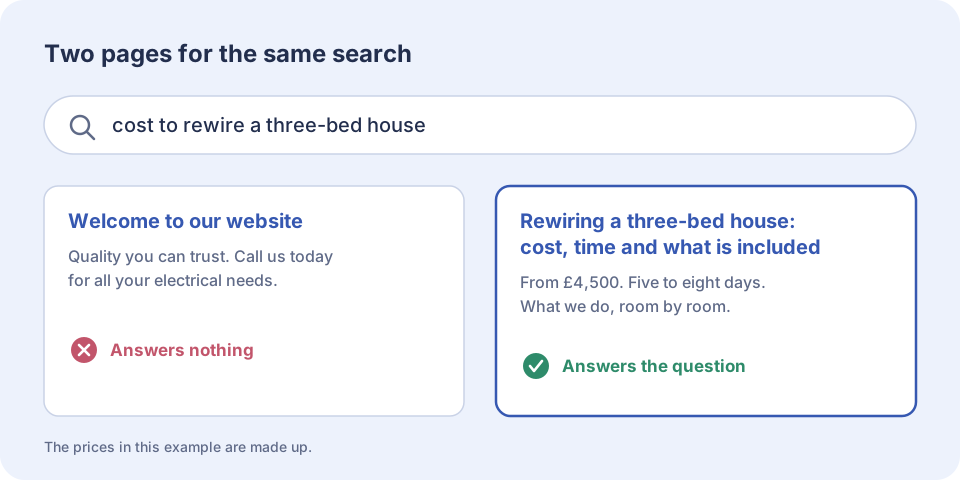
Think about what people type. Nobody searches for "welcome to our website" or "quality you can trust". They type a need: emergency electrician Croydon, cost to rewire a three-bed house, wedding florist near me. Each search is a question, and Google is looking for the page that answers it most completely.
Google describes what it wants as helpful, reliable content written for people first. That is less mysterious than it sounds. It means a page that leaves the reader with nothing left to ask.
One page for each thing you do
A single Services page that lists everything in one paragraph cannot answer any question well. Give each main service a page of its own. A page about bathroom fitting can then cover what is included, how long it takes, roughly what it costs, which areas you cover and what past jobs looked like. That page has a real chance of being the best answer to a search about bathroom fitting. One line in a list does not.
Answer the questions you get on the phone
You already know what customers want to know, because they ask you every week. Write those questions down, then answer them on the page in the same plain words you would use on the phone:
- How much does it cost? A range or a starting price is far better than "call for a quote".
- How long will it take, and how soon can you start?
- Which areas do you cover?
- What is included, and what is extra?
- What happens if something goes wrong?
Pages that answer these do better with Google, and they do better with customers. Someone who has read your prices and still gets in touch is a much warmer lead.
Use your customers' words, not your trade's
If the trade says "wet underfloor heating system" and customers type "underfloor heating cost", write the page in the customers' words. You can still be precise further down.
What to avoid
- Pages that repeat a phrase over and over to please Google. It stopped working long ago, and it reads badly.
- Dozens of near-identical pages with only the town name changed. Google treats these as spam.
- Text copied from a supplier or a competitor. Google already has that page.
- Thin pages with two sentences and a stock photograph.
When we build a site we plan the pages around the questions your customers ask, before any design is done. A good-looking page that answers nothing will not be found. Our process page sets out how that planning works, and there are worked examples by trade.