

Journal/Getting found on Google
Does website speed affect your Google ranking?
Yes, a little, and it affects your customers a lot. Here is what Google measures, in plain English, and what slows most small-business sites down.
15 November 2026·3 min read
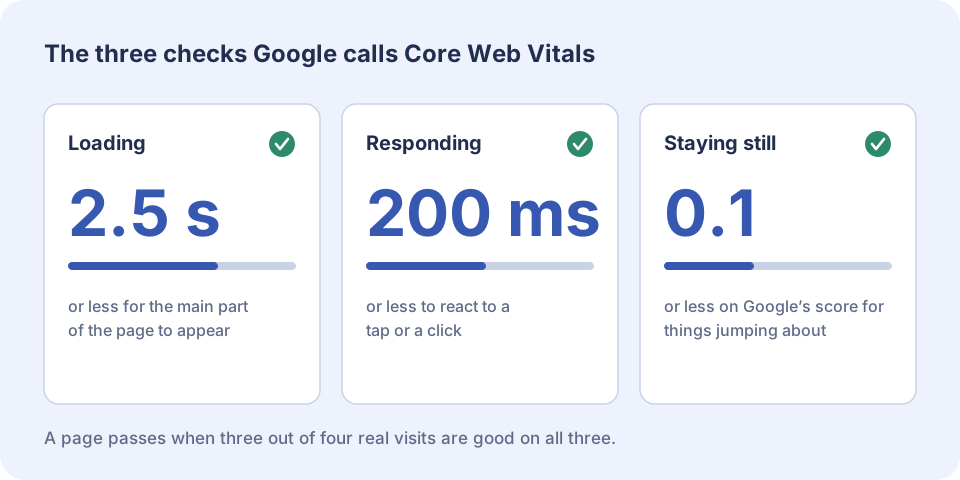
Google has said for years that it wants to send people to pages that work well. Since 2021 it has measured that with three checks it calls Core Web Vitals. They are taken from real visits by real people using Chrome, not from a test in a lab.
The three things Google measures
- Loading: how long the main part of the page takes to appear. Google calls it good at 2.5 seconds or less.
- Responding: how quickly the page reacts when someone taps or clicks. Good is 200 milliseconds or less, which is a fifth of a second.
- Staying still: whether things jump about while the page loads, so that you tap the wrong button. Google gives this a score, and good is 0.1 or less.
A page passes when three out of four visits are good on all three. That last part matters. Your own phone on your office wifi is not the test. The test is your customers, on their phones, on whatever signal they have.
How much does it matter?
Be wary of anyone who says speed alone will get you to the top. Google is clear that the most useful, relevant page wins, even if it is not the fastest. Speed is a tie-breaker between pages that are otherwise close. In most local markets, though, the pages are close. Ten plumbers or ten plasterers in one town tend to say similar things, and that is exactly where a tie-breaker counts.
The bigger effect is on people. A visitor who waits is a visitor who goes back to the results and taps the next name. That costs you the enquiry whether or not it costs you the ranking.
What slows a small-business website down
We tested the home pages of 12 WordPress sites from one UK trade and compared them with a hand-coded site in the same trade. The middle WordPress site made visitors download about three times as much code, styling and fonts, and fetch twice as many files. The heaviest page weighed 26 MB, most of it one video. The figures are on our how it's built page.
The causes are nearly always the same:
- Add-ons. Each one loads its own code on every page, whether that page uses it or not.
- Pictures uploaded straight from a phone or camera, many times larger than the screen needs.
- Fonts, maps, chat boxes and trackers fetched from other companies.
- Cheap shared hosting that takes a long time to answer at all.
What to do about it
Start by measuring. Our own website checker shows what a page is built on and what it asks a visitor to download. Google's free PageSpeed Insights tool shows the three checks for any page, using real visitor data where it has enough. If the results are poor, shrinking the pictures and removing add-ons you do not use are the cheapest wins. If the site is built on a heavy template, there is a limit to how far tuning will take it.
That limit is the reason we write every site by hand. There is no template and there are no add-ons, so there is very little to slow the page down. We will not promise you a score, because that depends on your visitors' phones and signal. We will show you exactly what the page weighs.